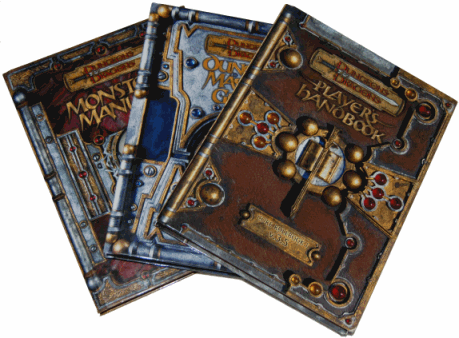
The following are rules that we have converted or created for 3E. Some balance the game and others make our game a bit more deadly. Use all, some, or none to spice up the adventure of the game. Feel free to submit any rules that you use.
1/2 Hit Point Rule: Well 3E came up with one so this old one stays with our 2E optional rules.
Called Shots: When a player, or monster, wants to make a called shot he should state it before the combat begins. The player states which of his attacks will be used for the called shots. The DM then determines the difficulty of the attack and applies a penalty to the attack roll.
| Weapon and Spell Modifiers | |
| Easy: -2 | Examples are hitting an opponent’s shield, tearing a shirt with a "Zorro" mark, hitting an arm or leg for no special effect. |
| Moderate: -4 | Examples are spiting in the face, hitting the leg for reduced movement, breaking a potion on their belt. |
| Difficult: -8 | Examples are hitting a hand making it useless, knocking off a helmet, slashing off armor straps, kick in the groin. |
| Ridiculous: -12 | Examples are decapitation, put out an eye, stake through the heart, using your sword as a tongue depressor. |
The attacker must then roll a successful critical hit to have the called strike go through. He would forfeit his 2x, 3x, 4x damage for the special effect, but if the effect is to decapitate then it would be better than the multiple damage dice. DMs should use these rules with caution. Be sure to give the appropriate penalty for the called shot. Remember they must first roll the threat range and then hit the opponent. Penalties apply to both rolls.
Critical Hits and Fumbles: Oh yes the dreaded table of death and destruction. The bane of many players. The tables add challenge and fun to combat. Never knowing when that 1 hit die orc is going to decapitate your 20th level warrior. We made our own tables and have put them on the site just for your killing enjoyment. As a DM you feel the criticals are too silly use common sense. A halfling can not decapitate a giant.
In 3E we use their critical hit method. We also adapt the fumble on the roll of a 1. On the roll of a 1 the attacker rolls again, if he misses his target’s AC, he fumbles.
Comeliness: Charisma should not count for beauty as it does in D&D. Hitler was not a handsome man but he was charismatic. A model can be stunningly beautiful and can be treated as a bimbo. Egor, a introverted hunchback, would neither be charismatic nor beautiful. We do understand, though, that charisma does influence comeliness. The charisma chart shows how charm affects comeliness. The modifications are exactly like 3E D&D ability charts.
| CHA | COM |
| 2-3 | -4 |
| 4-5 | -3 |
| 6-7 | -2 |
| 8-9 | -1 |
| 10-11 | 0 |
| 12-13 | +1 |
| 14-15 | +2 |
| 16-17 | +3 |
| 18-19 | +4 |
3E Critical Hits and Fumbles Table (ZIP, 265 kb)
Initiative: We saw the way 3E did their initiative system and we did not approve. The thought that a fighter getting all 5 of his attacks off before the wizard can cast their spell was a bit harsh. This is especially annoying if your wizard lost initiative by one point. So we devised this:
| Weapon and Spell Modifiers | |
| Small or lower weapons | 1 speed |
| Medium weapons | 2 speed |
| Large weapons | 3 speed |
| Huge weapons or more | 4 speed |
| 1-3 level spells | 1 speed |
| 4-6 level spells | 2 speed |
| 7-9 level spells | 3 speed |
| Partial Action | 2 speed |
The monster or player rolls their initiative (d20) and adds initiative modifiers. One subtracts the speed of the spell being cast or the weapon speed being wielded from the die roll. Each separate attack is deducted from the initiative for each attack.
Monsters with natural weapons add one lower speed than their size. A human punching (size: medium) would have his punch at a small size for speed. An ogre (size: large) beating people with his fists would have a size medium fist. A huge creature with claws would have a size large for his fist. Reason is that using your fists is easier than using a weapon, less weight and the being is used to his arms a lot more than a weapon.
A fighter with 3 attacks wielding a long sword rolls an 18. He adds 2 for DEX for a total of 20. He attacks with a full round action on 18, 16, 14. If he did a half move he would start moving on 20, finish on 18, and attack on 16. If it was a wizard casting ice prismatic spray his start time for the spell would be 20 and his finish time would be 17. He could get disrupted anywhere between those 2 times in the round.
Now this might be a bit confusing and a pain to do, but once you get used to it as a DM it adds a sense of urgency to battles. Attacks of opportunity are allowed and are with a 0 modifier.
Parry: Before a combat round begins a player may designate any number of his attacks as a parry. The player selects as many of his opponent’s attacks as he put into parrying, usually the BIG ones, and if that attack hits a parry is possible. The parrying player rolls an attack roll against the total attack roll of the opponent (d20 + bonuses). He must at least match it in order to parry the attack. A natural attack roll of 20 can only be parried with a natural parry roll of 20. If the attack is parried no damage is suffered.
Note that some attacks can’t be parried. A halfling can’t parry a hill giants club for example. The parrying weapon must be a solid object, a sword, a club, a chair. It can’t be a pillow, a net, or a whip for example. Use common sense.
Perception: Replaced by skills in 3E. We leave this one for the 2E rules
Shield Mastery Feat: Double the AC bonus of a shield. Only double the non-magical bonus of the shield. Preq. +6 attack roll.
Spell Memorization: We wanted spell casters to have a bit more flexibility so we allowed them to cast spells on the fly, no memorization required. They can cast any spell they scribed in their spell book if they are capable of casting that spell. They may only cast as many spells per day of each level as they could if they had to memorize them. Other spell casters have all spells in their spheres available to them.
Each “spells per level gained” is like a storage for their power. A 7th level wizard casts “slow” to cripple his opponents in combat he uses a 3rd level spell slot. Later he finds a stinking cloud is ruining his party’s meal so he “casts a gust of wind” to remove it. The wizard may no longer cast any 3rd level spells till he studies his spellbook and recover those spell levels but he still has any 4 1st, 2 2nd, and 1 4th level spell that he may cast that is in his book. Priestly spell levels must be prayed for instead of studied.
Sorcerers convert their spells per level into spell points. Each allowable spell per day is converted to points on a level spell per point basis and added to the sorcerer’s pool. Zero level spells are 1/2 a point. For example: Xran has 7 (0 level) 5 (1st), 4 (2nd), 3 (3rd), and 2 (4th) level spells he is able to cast a day. Now lets convert it to spell points: 7×1/2 + 5×1 + 4×2 + 3×3 + 2×4 = 33 1/2 spell points a day.
Each time he casts a spell, that spell level is deducted from his spell point total.
Stoneskin Spell: Ahhhh better. We leave our 2E rules for it. I still say it should be wizard only though.
Sweeping: They have rules for that in 3E also.